Three days from now the 2026 season plays its first full week, and for once we are not going to wait for the results to measure something. The slate itself is a designed object — somebody chose these 91 games, these five days, these three rented stadiums — so on August 31 we pulled the real week-one schedule from ESPN’s public scoreboard (state pre, nothing invented) and counted what television and the athletic directors actually built. The headline: the buy-game wall still holds a majority of the week — 48 of 91 games have a non-FBS visitor — but the calendar around it has been rebuilt. Thursday, 2024’s FCS costume party, is half gone. Sunday, which held exactly one game in the entire cached 2024 season, now holds three, including the week’s only ranked-vs-ranked matchup. The wall stayed; the shop window moved.
The shape of the week
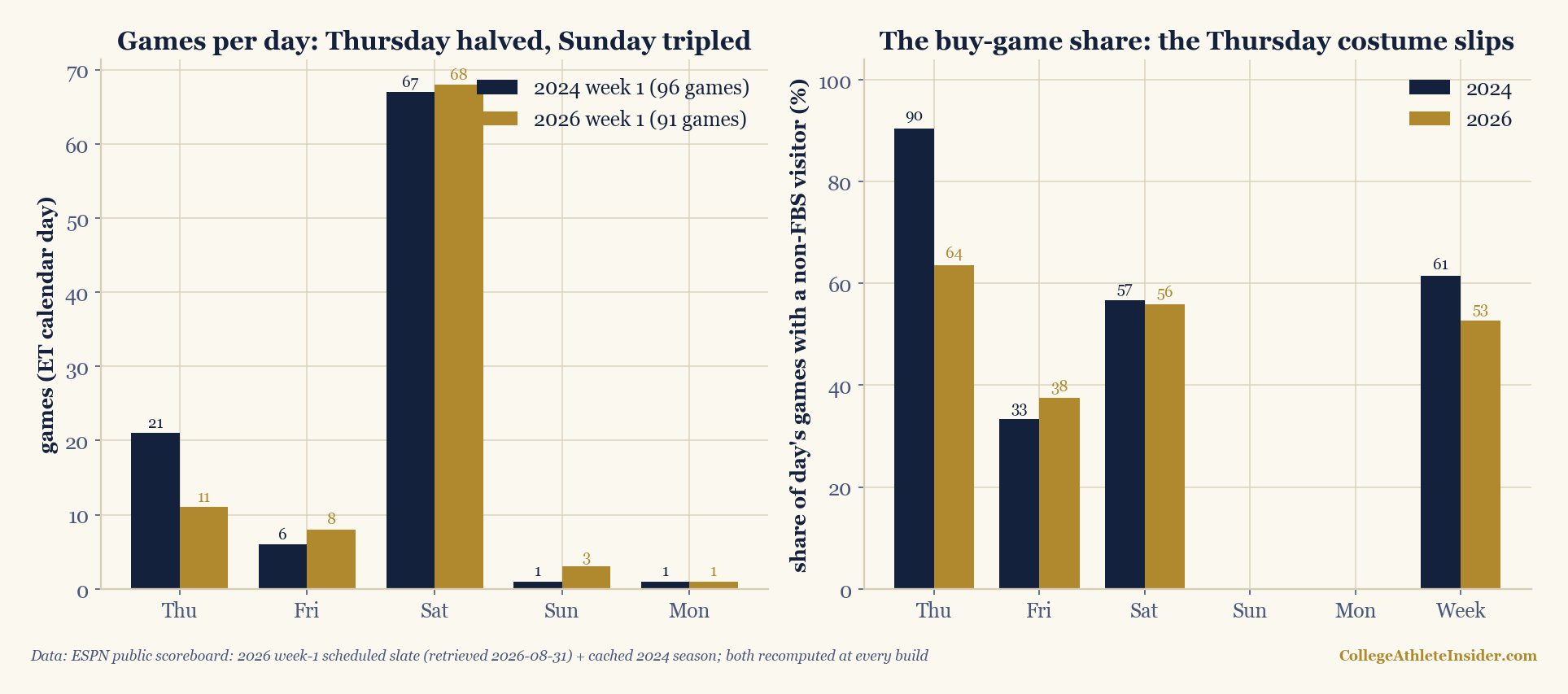
Week one runs Thursday, September 3 through Labor Day Monday, September 7: 11 games Thursday, 8 Friday, a 68-game Saturday wall running 12:00 to 10:30 PM Eastern, 3 Sunday, 1 Monday. Set that against the same Thursday-through-Monday window in 2024 — 96 games at 21/6/67/1/1 — and the redesign is visible in one glance: Thursday halved (21 to 11), Friday grew (6 to 8), Saturday held (67 to 68), Sunday tripled (1 to 3). All days are Eastern-time calendar days; ESPN stamps kickoffs in UTC, and the house conversion lesson applies to schedules exactly as it does to results.
The wall holds — thinner, and with new bricks
The opening-week audit measured 2024’s window at 61 buy games in 100 and called the structure durable. It was mostly right. The 2026 week carries 48 games with a non-FBS visitor — 52.7% of the slate, against 61.5% in the same 2024 window (59 of 96). The wall’s address changed more than its size: Thursday’s buy share collapsed from 19 of 21 (90.5%) to 7 of 11 (63.6%), while Saturday still runs majority-subsidy at 38 of 68. And in both seasons the count of buy games on Sunday and Monday is zero — whatever else changes, the premium windows are kept clean of them.
Two of the 48 hosts were not FBS programs a year ago. North Dakota State, now a Mountain West member, hosts Fordham; Sacramento State, now MAC football, hosts Mississippi Valley State. Both moves are verified against the schools’ own announcements, and both fit the pattern the buy-game audit priced out: the first thing a program does with FBS membership is schedule the product it just stopped being.
Sunday is the new shop window
The 2024 cache held one Sunday game and one Monday game all season, both in week one — exclusive windows television buys when the NFL hasn’t started. In 2026 the league’s schedulers tripled the Sunday bet: Washington State at Washington (an Apple Cup moved to a Sunday), Louisville–Ole Miss at Nissan Stadium in Nashville, and Wisconsin–Notre Dame at Lambeau Field. Monday night belongs to SMU at Florida State. Note what those four are: all FBS-vs-FBS, two of the week’s three neutral-site events, and — by ESPN’s own rank labels on the pull — the week’s only ranked-vs-ranked game, No. 24 Louisville against No. 9 Ole Miss. Out of 91 games, 24 carry a ranked side; exactly one pairs two of them, and it plays opposite the NFL’s opening Sunday rather than inside the Saturday wall.
The kickoff-classic industry itself is steady: 3 neutral-site games (3.3% of the slate) against the 1.3% mid-season baseline the 2024 cache measured — Baylor–Auburn at Mercedes-Benz Stadium being the Saturday entry. The 2024 window also ran three genuine classics; the difference is placement. Two of 2026’s three rented stadiums host on Sunday.
What the slate loads into September
The unbeaten-survival replay found that 2024’s perfect records were minted against non-FBS opposition — unbeaten teams went 77–1 in those games, 61 wins in August alone — and that real eliminations come from unbeaten-vs-unbeaten collisions. The 2026 calendar starts a week later, so that entire August subsidy now lands in September: 48 scheduled non-FBS games in week one alone, each a near-automatic 1–0. The collision supply is real but thin: 8 P4-vs-P4 pairings (Colorado–Georgia Tech is Thursday’s only one; Clemson–LSU is Saturday’s biggest; Baylor–Auburn, Louisville–Ole Miss, and SMU–Florida State fill the neutral and Monday windows), plus Wisconsin–Notre Dame just outside the count because Notre Dame answers to nobody’s conference id. Three of those pairings are already conference games — Miami at Stanford on Friday night, SMU at Florida State on Monday, and UNLV at Hawai’i over in the Mountain West — losses that count double before most teams have unpacked.
A worked example of reading a day: Thursday’s 11 games are 7 buy games, 3 games of Group-of-Five-at-power paycheck football (UMass–Rutgers, Akron–Wake Forest, UAB–Illinois), and exactly one power collision, Colorado at Georgia Tech. And ESPN’s four top-ranked hosts show how the powers spend the week: No. 1 Ohio State opens with Ball State, No. 3 Georgia with FCS Tennessee State, No. 2 Oregon at least drew a live Boise State — and only No. 4 Notre Dame chose a power opponent, Wisconsin at Lambeau.
Where this can mislead you
- A schedule is not a season. These 91 games are facts of the calendar as pulled on August 31; kickoff times move, and nothing here predicts a single result.
- “Ranked” is ESPN’s label. Rank numbers are the scoreboard feed’s own
curatedRankvalues, recorded verbatim and used only to label matchups — not this site’s ratings. - The FBS classifier has a vintage. A 2026 visitor counts as FBS when its conference id appears in the set observed on the 2024 cache’s 134-team proxy. That works this year because every 2026 newcomer joined a conference that already existed — verified for North Dakota State (Mountain West) and Sacramento State (MAC) — but it is a rule worth re-deriving each season.
- “Week” is a definition. Thursday-through-Monday Eastern calendar days, same as the 2024 comparison window; the buy-game audit’s week-ending-Saturday bucket scores 2024 at 62.8%, our calendar window at 61.5% — different definitions, same story.
- Week zero is its own piece. The games already played on August 29 are measured separately in the week-zero audit; nothing from those results leaks into these counts.
Reproduce it
data_layer/build_week1_2026_slate.py pulls the scheduled slate (UTC days September 2–8, kept where the Eastern date falls September 3–7, deduped by event id, state == pre) and stamps the retrieval date; charts/chart_week1_2026_slate.py recomputes every number above — both years — at every charts build and warns if either side stops reproducing. The core:
2026: 91 games — Thu 11 / Fri 8 / Sat 68 / Sun 3 / Mon 1
buy games (non-FBS visitor): 48 of 91 = 52.7%   # 2024 window: 59/96 = 61.5%
Thursday buy share: 7/11 = 63.6%                 # 2024: 19/21 = 90.5%
neutral sites: 3 (3.3%)  ranked-vs-ranked: 1     # LOU–MISS, Nashville, Sunday
P4-vs-P4: 8   conference games: 3   Sun+Mon buy games: 0
Sources & further reading
- Data: ESPN’s public college-football scoreboard API (
site.api.espn.com/…/scoreboard?dates=YYYYMMDD&groups=80), scheduled events retrieved 2026-08-31 and bundled atdata_layer/week1_2026_slate.json; the 2024 comparison uses our locally cached scoreboard responses (877 games, provenance indata_layer/SOURCE.txt). - FBS membership moves verified via North Dakota State athletics (first Mountain West/FBS season) and Sacramento State athletics (MAC football from 2026), with ESPN’s report as the second source.
- Related: what an opening week is, measured (the 2024 portrait these numbers are tested against), week zero 2026, measured (the weekend that just played), the last unbeaten (why the buy-game count is September’s survival subsidy), the FCS buy game, measured, and weeknight football, measured (why Sunday and Monday windows exist at all).