The 2026 season opened Saturday in Fargo with a result that would have been the upset of the year in any previous August: North Dakota State 33, Jacksonville State 7. It wasn’t an upset. It wasn’t even an FCS team beating an FBS team, which is what that scoreline has meant for two decades — it was North Dakota State’s first game as an FBS member, a Mountain West program hosting a Conference USA one, and the Bison won it by 26. Across the country, Sacramento State — the other name on the slate that reads FCS — was losing at Eastern Michigan in a game ESPN’s own feed codes as a MAC conference game, because the Hornets joined the MAC as a football-only member this July. Put those two reclassifications together and you get the real headline of the weekend, which is structural: week zero 2026 was eight games involving sixteen FBS teams and not a single FCS participant. The opening weekend’s only wildcard — the visiting ambush that produced the 2024 season’s first upset — has gone extinct, at least for this slate, and it went extinct by promotion.
What eight games produced
All eight completed games were played Saturday, August 29. The home teams went 6–1, with Memphis’s 27–21 win at UNLV the only road success and North Carolina’s 15–10 win over TCU in Dublin the neutral-site exception. The one ranked side on the slate, No. 14 USC, beat San José State 42–26, so the weekend ended with zero ranked losses and zero losses to lower-division teams — nothing anyone’s definition would call an upset, unless you count Virginia opening league play by dropping 34 on NC State in one of the sport’s odd week-zero conference games. Scoring ran to 47.9 points a game across the slate, against 53.3 for 2024’s four-game opening weekend, and four of the eight games were decided by 11 points or fewer. The closest and lowest-scoring game of the weekend was Dublin’s, for the second straight year: 25 total points this time, after Georgia Tech’s 24–21 win over Florida State (45 points) held the same title in 2024. Whatever the Aer Lingus Classic does to teams, it does not do offense — and North Carolina’s 15 points were the fewest by any winner on the slate.
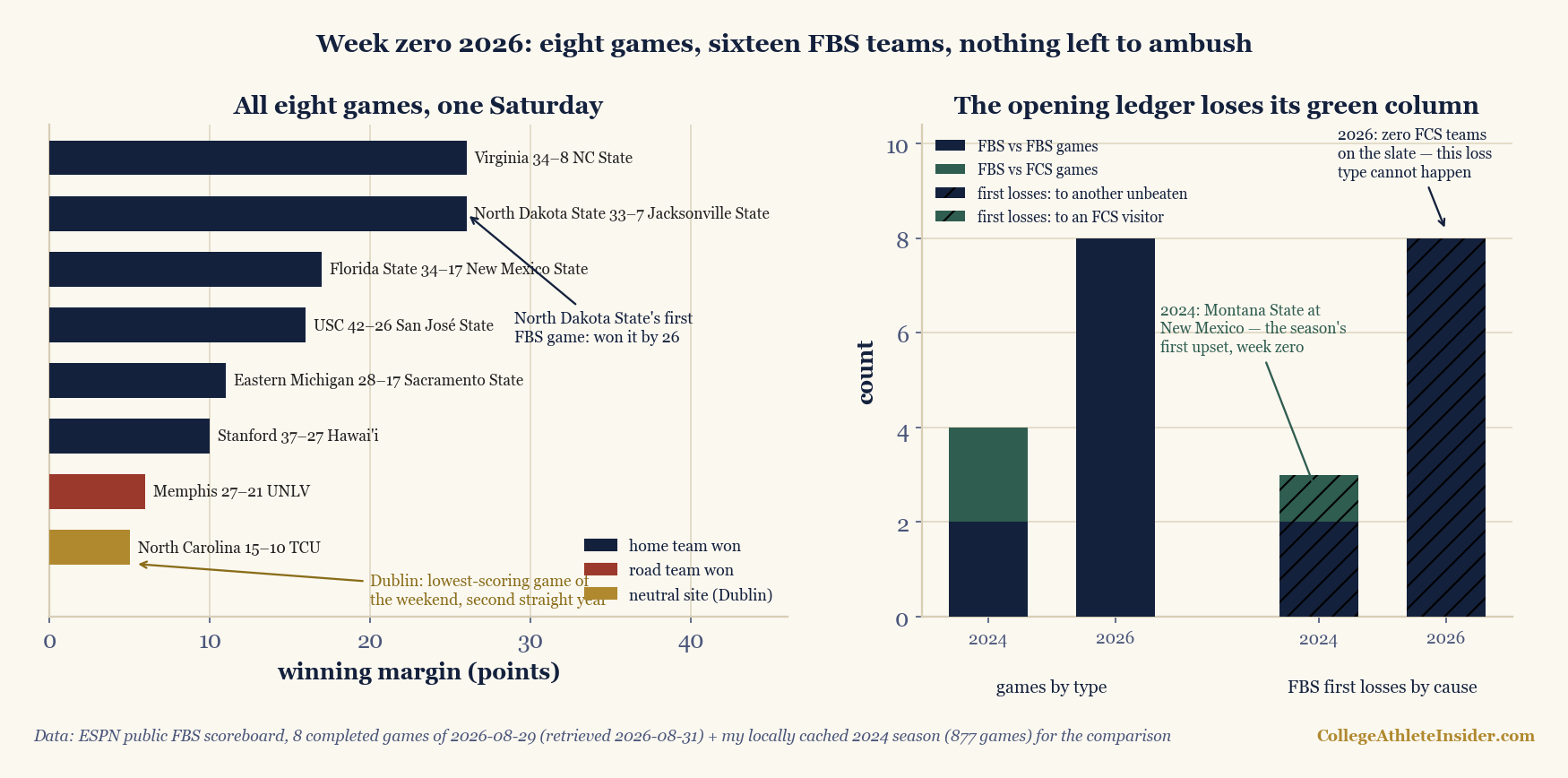
data_layer/week0_2026_results.json), plus our locally cached 2024 season for the comparison. Computed and pinned by charts/chart_week0_2026.py — 50 checks.When every game is FBS vs FBS, the arithmetic stops being a forecast
The unbeaten-survival piece made a small cult of week zero: the one weekend whose results matched the coin-flip null exactly, because it was the one weekend without a buy-game subsidy to distort it — six FBS teams played in 2024, three lost. But 2024’s slate still had range. With two FBS-vs-FBS games (each guaranteed to kill one unbeaten) and two FBS-vs-FCS games (each a genuine question), the weekend could have ended with two, three, or four FBS losses. It landed on three, the midpoint, and the one FCS kill — Montana State 35, New Mexico 31 — was the entire season’s first upset and its only successful FCS ambush.
2026 removed the range. Eight FBS-vs-FBS games mean exactly eight of the sixteen teams took a loss, with certainty, before a single snap. The null didn’t hold this year; it became an identity. There is no subsidy to measure, no ambush to price, and nothing for luck to do except choose which eight. That is a real change in what the opening weekend is for. Week zero used to be the sport’s one honest coin flip; this year it was a ledger entry that filled itself in, and the information moved entirely into the margins — Virginia by 26 over a conference opponent says something; the mere fact that half the field lost says nothing at all.
The two promotions, stated exactly
North Dakota State — ten FCS national titles, all since 2011, the program whose visits FBS schedulers learned to fear — opened its first Football Bowl Subdivision season as a Mountain West member, at home, against a Jacksonville State side in its own fourth FBS year, and won 33–7. Sacramento State left the Big Sky — the same conference that produced Montana State, 2024’s only FCS killer — for a five-year football-only MAC membership, and lost its FBS debut 28–17 at Eastern Michigan. The honesty fine print matters here: both programs are inside the NCAA’s two-year reclassification window, which leaves the Bison ineligible for postseason play until 2028 and keeps the Hornets out of the MAC title game through the same transition. Their games count fully for their opponents’ records and for the unbeaten ledger; their own Novembers are capped by rule, not by results. So the two most storied names of the FCS ambush era now live on the other side of it — which is exactly why the slate had no rose column left.
A worked example: what week zero’s losers became
Does an opening-weekend loss mean anything? Run 2024 forward as the base rate. The three FBS teams that lost that weekend finished the cached season a combined 10–27: Florida State 2–10, Nevada 3–10, New Mexico 5–7. The three FBS winners finished 23–15 — Georgia Tech 7–5, SMU 11–3 and a College Football Playoff berth, Hawai’i 5–7. That is a .270 season against a .605 one, sorted by a single August game — and it is also three teams a side, which is why this is a worked example and not a finding. Hawai’i sits in the winners’ column at 5–7 as the resident warning: it won its opener and still carried a loss by the first Tuesday of September. If the pattern holds even loosely, TCU, NC State, Jacksonville State and the rest of Saturday’s 0–1 club are not doomed — but the base rate they’d like to cite is not on their side.
Limits
Eight games. Every 2026 number above is a fact about one Saturday, not an estimate of anything; the 2024 comparison is four games more. Averages over samples this size (47.9 vs 53.3 points) are reported because they are true, not because they are stable. “Week zero” is the sport’s label, not ESPN’s — the feed numbers the opening weekend as week 1, and this piece uses the colloquial name. FBS membership is read from ESPN’s own conference IDs, checked against the conference set of the 134-team 2024 cache, with the two new members verified against their schools’ and conferences’ announcements; if ESPN misclassified a competitor, the classification here inherits it. “No upsets” is a structural claim — no ranked side lost and no lower-division team beat an FBS one. This site doesn’t use betting lines, so a favorite losing as such is outside the definition. And the FCS ambush is extinct on this slate, not in the sport: FBS teams will host FCS visitors by the dozen starting next Saturday, when the buy-game subsidy that the buy-game piece priced comes back online at full volume.
Reproduce it
data_layer/build_week0_2026.py pulls the completed opening-weekend scoreboard from ESPN’s public API (the endpoint is named in the file), keeps completed games only, and bundles them with the FBS conference-ID set derived from the same cached 2024 season every other piece on this site replays. charts/chart_week0_2026.py rebuilds the figure and re-verifies 50 published numbers — every score, margin, flag and 2024 comparison above — against both datasets, warning loudly on any drift. The 2024 week-zero replay uses chart_weeknight.load_games() verbatim, so the game set and guards match the unbeaten piece and the weeknight piece exactly.
Next Saturday the real thing starts: a hundred-plus games, the subsidy at full flow, and the unbeaten pool’s annual cliff — measured here from the 2024 cache before it happens. Week zero used to be the weekend that could surprise you. This year it was the weekend that couldn’t, by construction — and the fact that the sport promoted its way out of its own best ambush story is, in its quiet administrative way, the most 2026 result on the board.
Sources
- ESPN public college football scoreboard API (
site.api.espn.com, groups=80), completed events of 2026-08-29, retrieved 2026-08-31 — bundled atdata_layer/week0_2026_results.json. - This site’s cached 2024 ESPN scoreboard responses (877 completed games) via
chart_weeknight.load_games(). - North Dakota State 2026 schedule announcement and FBSchedules on the Bison’s FBS debut (Mountain West membership; postseason ineligibility until 2028).
- Mid-American Conference announcement on Sacramento State’s five-year football-only membership and the two-year FCS-to-FBS transition.