Watch a heavy underdog in March and you'll see the same playbook: milk the shot clock, hold the ball, turn a 70-possession game into a 60-possession rock fight. Casual fans call it boring. It's actually the single most rational thing a worse team can do, and the reason is pure mathematics. The fewer possessions there are, the more a game is decided by luck rather than talent — and luck is the underdog's only friend. Slowing the game down doesn't make the underdog better. It makes the better team's edge matter less.
The model: a game is a random walk
Think of the scoring margin — favorite minus underdog — as a random walk that takes one step per possession. After n possessions, that margin is approximately a bell curve with two parts:
- Mean = e × n, where
eis the favorite's edge per possession. More possessions, more chances for the better team to pull ahead. The talent gap grows linearly withn. - Standard deviation = s × √n, where
sis the per-possession scoring noise. Randomness grows too — but only with the square root ofn.
The underdog wins when the margin lands below zero, which happens with probability:
P(upset) = Φ( −(e/s) × √n )
Here's the punchline hiding in that formula: the talent term grows like n, the noise term only like √n, so as the game gets longer the signal outruns the noise and the favorite's win becomes more certain. Run fewer possessions and you do the reverse — you keep the random walk short, before the favorite's edge has had time to compound.
The curves: slowing it down, quantified
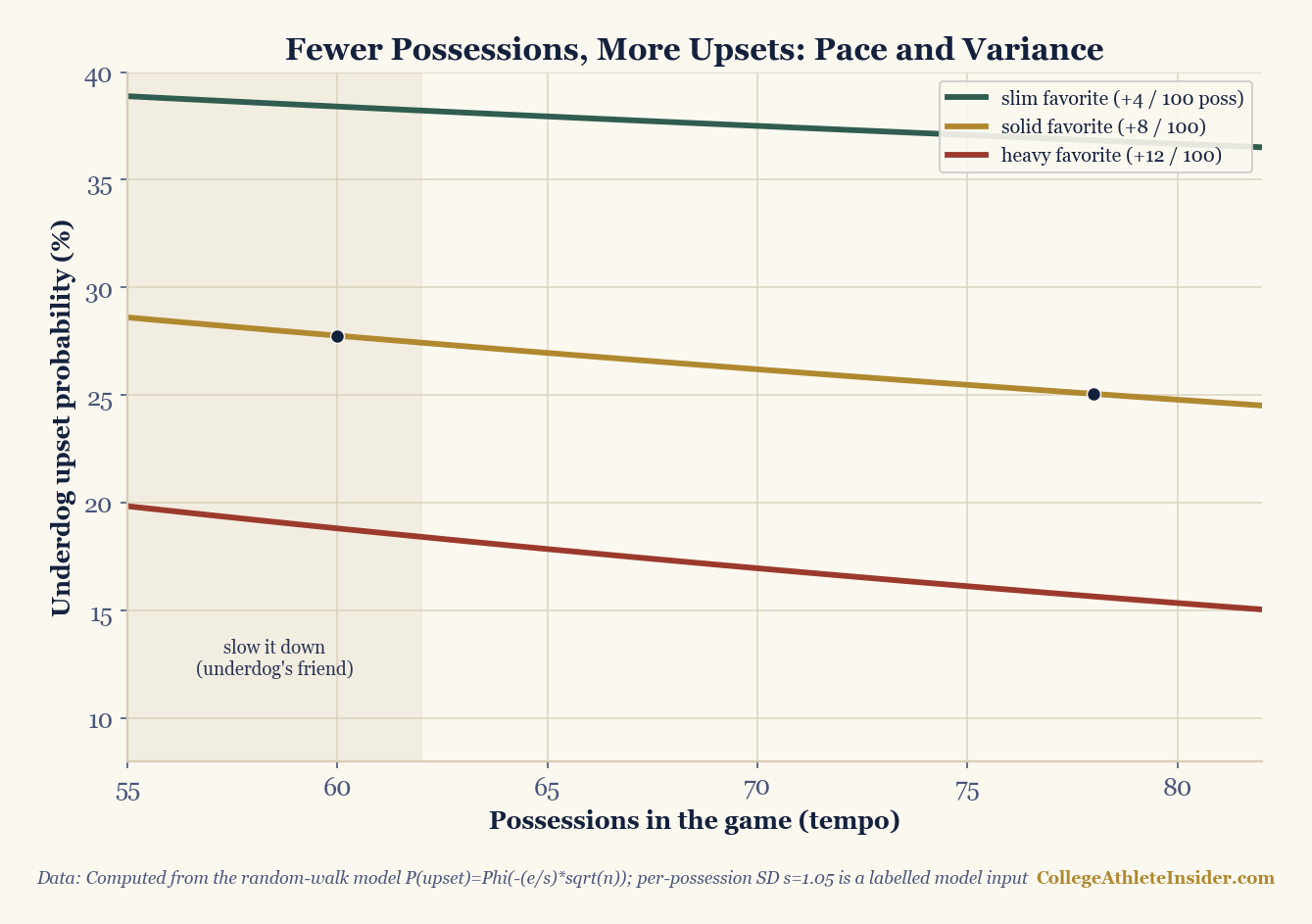
Take a heavy favorite (a team better by 12 points per 100 possessions). In a fast, 78-possession track meet, the underdog's upset chance is about 15.6%. Drag the same game down to 60 possessions and it climbs to 18.8% — a 3-point bump that is a 20% relative increase in upset odds, just from holding the ball. For a solid favorite (+8/100) it moves from 25.1% at 78 possessions to 27.8% at 60. The effect is modest in absolute terms and meaningful in relative terms: slowing the game turns some losses into coin-flips and some blowouts into nervous finishes.
The other lever: raising the variance
Pace isn't the only way to feed the upset formula. Look again at P(upset) = Φ(−(e/s)√n): it also rises when s, the per-possession variance, goes up. That's the second half of the underdog's toolkit and it's why you see worse teams:
- Shoot threes. A three-heavy diet is higher-variance than grinding out twos — some nights it floods, some nights it floods the favorite, but variance is exactly what the underdog wants more of.
- Press and gamble. Forcing turnovers and chaos widens the range of outcomes. A disciplined game suits the better team; a messy one suits the worse one.
- Foul late when trailing. Intentional fouls in the final minute are a desperate variance-injection — trading expected points for a wider distribution that occasionally lands on a win.
Slow tempo lowers n; chaos raises s. Both shrink the ratio that determines how certain the favorite's win is. The best underdog game plans do both at once: few possessions, each one wild.
A worked example
A 14-seed draws a 3-seed that's better by roughly 12 points per 100. Played at the 3-seed's preferred 75-possession pace, the upset math sits around 16%. Now the 14-seed slows it to 60 possessions and jacks up its three-point rate to push the per-possession variance higher. The pace change alone lifts the upset odds to ~19%; the added variance pushes it higher still. None of this closed the talent gap — the 3-seed is exactly as good as it was. The underdog simply changed the shape of the distribution so that more of it falls on its side of zero. That's the entire science of the March upset.
Where the model is too clean
- Slowing down can shrink the edge, not just the variance. Some favorites are built to score in transition; force them into the half-court and you also reduce
e, which helps the underdog beyond the pure-pace effect. The model treatseas fixed, which understates the benefit against run-and-gun teams (and overstates it against great half-court teams). - Variance cuts both ways. Raising
sraises the upset chance, but it also raises the chance of a blowout loss. The underdog accepts uglier defeats in exchange for the occasional win — rational when you're trying to win one game, not maximize average margin. - Possessions aren't independent, identical steps. Late-game fouling, momentum, and score-dependent strategy bend the simple random walk. The formula is a clean first approximation, not a play-by-play simulator.
- The per-possession SD is a stand-in. The exact upset numbers shift with the value of
s; treat the curves as the right shape and rough magnitude, not precise odds.
The takeaway
“Shorten the game” is the underdog's oldest instinct, and it's correct for a reason most fans never hear: talent compounds with possessions, but luck only grows with the square root of them. Fewer possessions keeps the random walk short, before the better team's edge can assert itself; more variance per possession widens the bell so its left tail dips below zero more often. The underdog can't out-talent anyone in 40 minutes — so it makes the 40 minutes as short and as chaotic as the rules allow, and waits for the math to do the rest.
Sources & further reading
- The random-walk model of a game margin (talent growing with
n, noise with√n) is standard; the upset curves here are computed directly fromP = Φ(−(e/s)√n), with the per-possession SD entered as a labelled model input. - Related: When is a lead safe? — the same random-walk logic applied to leads and the clock.
- Related: Bracket math: seeds and upset odds — how seed gaps translate into win probabilities.
- Related: Adjusted tempo and efficiency — how pace is measured and why per-possession ratings matter.