Every rating system — Elo, the ones behind the playoff committee's favorite metrics, your video game's matchmaking — has one dial that quietly decides everything: how much to move a team's rating after a single game. Move it too much and the rating chases every fluke; move it too little and it takes half a season to notice a team got good. That dial is the K-factor, and the tension it manages — react fast versus stay steady — is the central tradeoff in turning game results into a number you can trust.
What the K-factor does
An Elo-style rating updates after each game by a simple rule:
new rating = old rating + K × (result − expected)
The (result − expected) part is the surprise — how far the outcome landed from what the rating predicted. K is how much of that surprise you bake in. A big K says “trust this game a lot”; a small K says “this is one data point, don't overreact.” Pick K and you've decided how much the system believes any single result.
The tradeoff, simulated
To see it, imagine one team that genuinely improves midseason — its true strength jumps at game 40 — and watch how ratings with different K values chase that change. (This is an illustrative seeded simulation, not real game data: the team plays average opponents and wins or loses according to its true strength, while three ratings try to track it.)
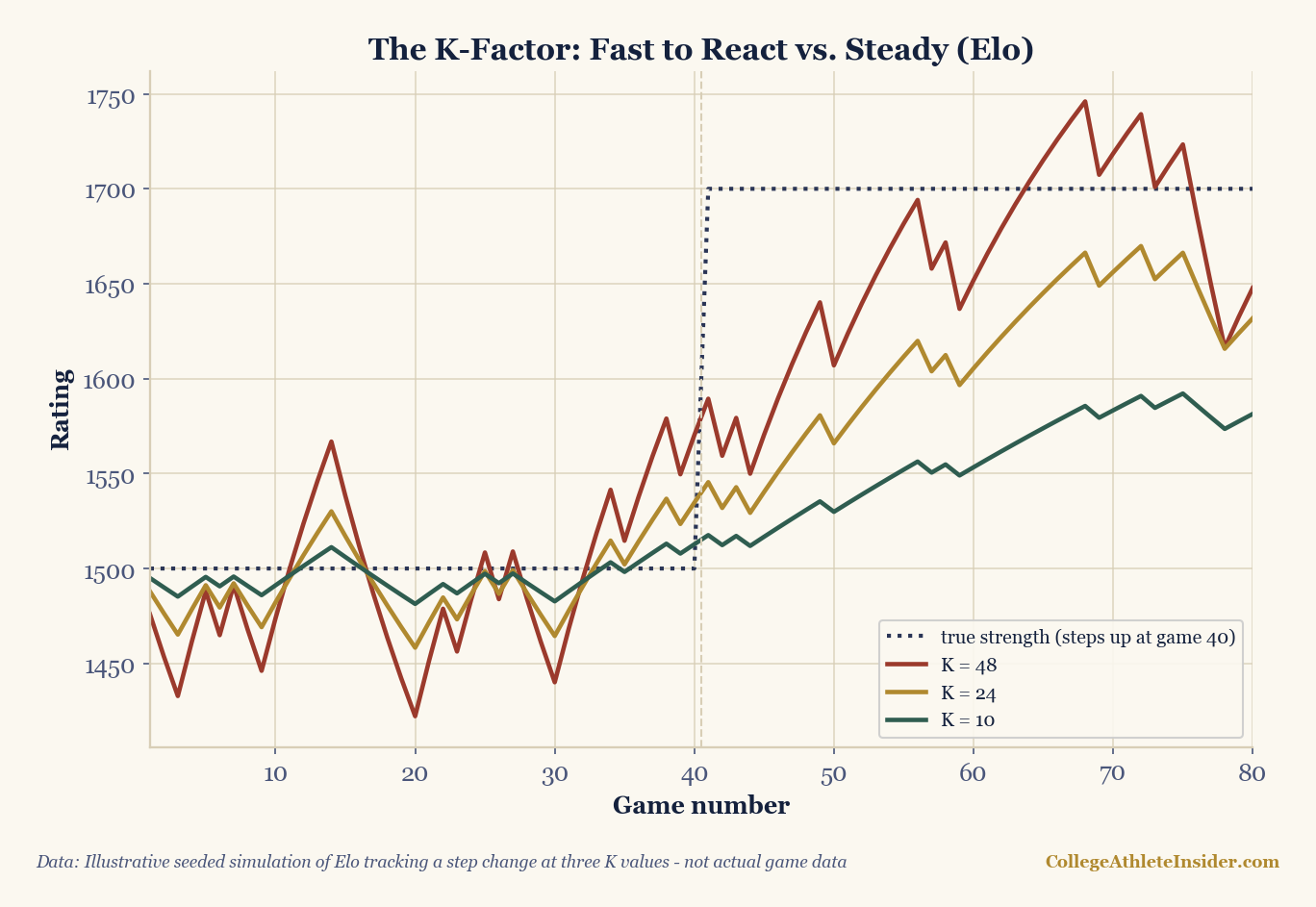
Read the three lines after the jump at game 40:
- K = 48 (fast): rockets toward the new 1700 level within a handful of games — but look at the jitter. It bounces above and below the true line constantly, because it overreacts to every individual win and loss. It's responsive and noisy.
- K = 10 (slow): beautifully smooth, almost no jitter — but it badly lags the change, still crawling toward 1700 many games later. By the time it agrees the team improved, the season's half over. It's stable and sluggish.
- K = 24 (middle): the usual compromise — catches the change at a reasonable pace without too much bounce. Most real systems live near here.
Why you can't have both
This isn't a tuning failure you can engineer away — it's a genuine tradeoff baked into the math. Each game's result is part real signal (the team's true strength) and part noise (a lucky bounce, a hot shooting night). A high K can't tell them apart, so it absorbs both: it tracks real change quickly and amplifies the noise. A low K filters the noise out, but filtering is just averaging over time, and averaging is slow — so it also smooths away real change. Responsiveness and stability are two ends of one slider; every K is a bet about how much of a single game is signal versus luck.
How real systems cope
Good rating systems don't pick one K and live with the compromise — they cheat the tradeoff with a few tricks:
- Decaying K. Use a big K early (when you know little and want to learn fast) and shrink it as a team's record builds (when the rating is already well-established). New teams move fast; settled teams move slowly.
- Margin-of-victory adjustment. Scale the update by how decisive the result was, so a blowout moves the rating more than a one-point escape — squeezing more signal out of each game without raising K across the board.
- Preseason priors. Start teams near a returning-production-informed estimate instead of a blank 1500, so the system isn't relying on a high K to climb out of ignorance in September.
- Blending with an opponent-adjusted rating. Pairing the reactive Elo with a slower, schedule-adjusted measure gets you both speed and stability from two systems rather than one dial.
Where the simple picture bends
- Real strength doesn't jump in a clean step. Teams improve and decline gradually (and via injuries, suddenly), so the ideal K depends on how fast true strength actually drifts in your sport — faster drift rewards a higher K.
- Schedule matters. This simulation used identical average opponents; in reality the surprise term already depends on opponent quality, and a poorly opponent-adjusted system will misread strength of schedule no matter what K you choose.
- The numbers are illustrative. The exact K values and the size of the jitter depend on the simulation's noise level; treat the chart as the right shape of the tradeoff, not precise settings for a specific sport.
- More games shrinks the dilemma. Over a long season the lag of a small K matters less; in a short season (or early in a long one) the responsiveness-vs-noise choice bites hardest.
The takeaway
The K-factor is where a rating system decides how gullible to be. Crank it up and the ratings are nervous — quick to crown and quick to bury, jumping at every result. Turn it down and they're stubborn — calm and reliable, but slow to admit a team has changed. There's no setting that's both, because a single game is part signal and part luck, and no dial separates them. The art of a good rating system isn't finding the perfect K; it's using decaying K, margin adjustments, and priors to stop having to choose.
Sources & further reading
- The K-factor and the Elo update rule originate with Arpad Elo's chess rating system; the responsiveness-vs-stability tradeoff is a general property of any exponential-update estimator. The chart is a labelled illustrative simulation, not real game data.
- Related: Elo and ratings tools on the Calculators hub — run rating updates yourself.
- Related: How rates regress to the mean and sample size and standard error — the same signal-vs-noise problem behind why one game shouldn't move a rating much.
- Related: Strength of schedule — the opponent adjustment a good rating needs alongside the right K.