Spend a week around college football and someone will tell you a team is "better than its record" because of SP+. It's one of the most cited advanced ratings in the sport and one of the most casually misunderstood — quoted like a verdict by people who couldn't tell you what it's measuring. So we'd rather build the thing up from the floor than ask you to take it on faith. By the end you'll know what SP+ actually measures, how it's put together, why opponent adjustment is the whole game, and the specific spots where it'll lead you wrong if you let it.
The one-sentence version: SP+ estimates how many points better or worse than average a team is, after accounting for who it played. Everything else is detail. This page also builds the skeleton of a rating like it from real 2026 scores, and tests one of its design choices — starting each season from a projection — against 1,399 real games.
How SP+ is calculated, in four steps
SP+, developed by Bill Connelly, is a play-by-play rating, and the order of operations matters more than any single formula:
- Grade plays, not games. The raw material is efficiency — success on a play-by-play basis (see our success rate and EPA explainer), not raw yards — and explosiveness, the value of the big plays a team produces and allows.
- Add the drive-level pieces. Field position and finishing drives: where drives start and whether they end in points.
- Adjust for opponents. All of the above is recalibrated for schedule strength, so the same numbers against a great defense count for more than against a poor one.
- Lean on a preseason projection early, then let it fade. With only a game or two played, the rating leans heavily on that projection; as games pile up, the season's own plays take over. The last section of this page measures why that's the right call.
The output is split into an offensive rating, a defensive rating, and a combined number expressed in points. A team with a +25 SP+ rating is, in expectation, about 25 points better than a perfectly average team on a neutral field. It is tempo-free by construction: because it works in per-play and per-drive terms, a fast, high-snap offense isn't flattered just for running more plays.
You can see the structure in the ratings themselves. CollegeFootballData.com serves SP+ ratings through its API, and its reference lists what each team's record holds: an overall rating and ranking, second-order wins and a strength-of-schedule figure, then separate offense, defense and special teams blocks. The offense block breaks into success, explosiveness, rushing, passing, standard downs, passing downs, pace and run rate; the defense block carries the same efficiency splits plus havoc, divided between the front seven and the defensive backs. That's the anatomy: a points number on top, built from efficiency and explosiveness underneath. The API needs a key, and we don't reproduce SP+'s own numbers here.
Why raw stats lie
Imagine two offenses that both average 6.5 yards per play. One did it against the toughest defenses in the country; the other padded its numbers against a soft non-conference slate. Their raw stats are identical, but they are not equally good. Raw, unadjusted numbers reward the team with the easier schedule. Every serious rating system exists to undo that distortion.
The fix is opponent adjustment: judge each performance relative to what a typical team does against that same opponent. Beat a great defense by a little, and you get credit. Beat a bad one by a little, and you don't.
A simple opponent adjustment, with real data
You don't need SP+'s machinery to see the principle work. Take every FBS team's average scoring margin in 2024, then add the average margin of the teams it played — one round of adjustment for schedule. Here's the top of that list, computed from public results by a script kept in our build repository and not published:
| Team | Raw margin | Adjusted |
|---|---|---|
| Ohio State | +18.5 | +21.3 |
| Notre Dame | +19.4 | +20.5 |
| Alabama | +13.0 | +17.8 |
| Oregon | +17.0 | +17.8 |
| Texas | +15.6 | +17.3 |
Notice what adjustment does to the bottom of the picture, too. Indiana went 11-1 and posted the third-best raw margin in the country (+18.2) — but its adjusted margin falls to about eleventh, because it played one of the softest schedules in major college football. That's not an insult to a great season; it's the entire point. SP+ does this same thing, far more rigorously.
Solving every schedule at once: a 2026 scores-only rating
One pass of adjustment has a flaw: it treats each opponent's raw margin as the truth, when that opponent's margin was itself earned against a schedule. The fix is to solve for every team at once. Give each team one number, say that the expected margin of any game is the home team's number minus the visitor's, plus 3 points for the home side (none at a neutral site), and find the set of numbers that misses the real final margins by the least, across every game played. That's the same idea as the iterated spreadsheet ranking, done in one step.
Two details keep it sane. Every team also gets four "phantom" games against a perfectly average opponent, finished in a tie, which keeps a team with a thin or lopsided schedule from flying off to an extreme. And FCS opponents share one pooled rating, except the two non-FBS teams playing full FBS conference schedules this year (North Dakota State and Sacramento State), which get their own. Splitting each game into two scores instead of one margin gives the same rating cut into an offense number (points scored above average, adjusted for the defenses faced) and a defense number (points kept off the board, adjusted for the offenses faced); the two add up exactly to the rating. Here is the top 15 through the games of Sunday, October 18 — 510 games involving FBS teams, in which the average team scored 26.7 points:
| # | Team | Record | Avg margin (rank) | Rating | Offense | Defense | With 2025 prior (rank) |
|---|---|---|---|---|---|---|---|
| 1 | Notre Dame | 6-1 | +27.7 (3) | +17.1 | +9.7 | +7.5 | +22.2 (2) |
| 2 | Miami | 6-0 | +34.5 (1) | +16.6 | +11.3 | +5.3 | +21.3 (3) |
| 3 | Ohio State | 6-1 | +25.9 (6) | +16.1 | +8.1 | +7.9 | +22.6 (1) |
| 4 | Alabama | 5-2 | +17.9 (18) | +14.3 | +9.0 | +5.3 | +19.3 (5) |
| 5 | LSU | 5-2 | +24.6 (8) | +14.1 | +7.7 | +6.3 | +16.2 (7) |
| 6 | Georgia | 6-1 | +27.1 (4) | +13.9 | +9.1 | +4.8 | +18.3 (6) |
| 7 | Indiana | 6-1 | +23.7 (9) | +13.4 | +4.7 | +8.8 | +20.8 (4) |
| 8 | James Madison | 7-0 | +26.9 (5) | +12.0 | +8.0 | +4.1 | +14.0 (11) |
| 9 | UCLA | 6-0 | +19.3 (13) | +11.7 | +5.1 | +6.6 | +10.6 (21) |
| 10 | Houston | 6-1 | +18.3 (16) | +11.4 | +7.5 | +4.0 | +11.7 (17) |
| 11 | Wake Forest | 6-1 | +18.0 (17) | +11.2 | +5.7 | +5.5 | +12.0 (16) |
| 12 | New Mexico | 5-1 | +29.2 (2) | +10.8 | +5.3 | +5.4 | +10.4 (22) |
| 13 | Texas | 4-2 | +12.3 (37) | +10.2 | +3.0 | +7.2 | +14.4 (10) |
| 14 | Utah | 6-0 | +25.3 (7) | +10.0 | +6.3 | +3.7 | +15.1 (9) |
| 15 | Oregon | 4-2 | +16.3 (23) | +9.9 | +5.6 | +4.3 | +15.1 (8) |
The adjustment is doing visible work. New Mexico's +29.2 average margin is the second-best in the country, and it lands 12th once the schedule is solved: its opponents rate 11.2 points worse than average. Texas is 4-2 with the 37th-best margin and rates 13th, because its opponents rate 6.1 points better than average. Farther down the list the moves are bigger: UCF climbs from 52nd on raw margin to 27th, and Toledo falls from 34th to 66th. Miami has the best raw margin and rates second; Notre Dame, third on raw margin and 6-1, rates first because its opponents average −0.8 to Miami's −6.8.
Be clear about what this is and isn't. It's the opponent-adjustment step of a rating like SP+, run on final scores. SP+ starts from plays, so it is tempo-free and rates special teams separately; this one is neither, and a lopsided score counts in full. Use it to see how the schedule moves a team, not as a stand-in for SP+'s numbers.
Why SP+ starts with a projection: we tested it
Step four above — begin the season from a projection and let the games take over — sounds like a hedge. It's the part of the design that's easiest to check with nothing but scores. So we ran the scores-only rating three ways, refitting every Monday of the 2025 season and the 2026 season so far and predicting every game of the following week:
- Last season only: each team's final rating from the year before, pulled 30% back toward average (the factor is the year-to-year slope we measured: across the 134 teams that were FBS in both 2024 and 2025, each point of 2024 rating carried 0.69 of a point into 2025, a correlation of 0.66). A team that wasn't rated on its own the year before starts at the old pooled FCS rating, scaled the same way.
- This season's scores only: the rating above, with its four phantom games played against an average team.
- Blended: the same four phantom games, but each one finishes with the margin last season's regressed rating predicts against an average team. Early on the phantoms dominate; by midseason a team has played more real games than phantom ones and its own results take over. That's the fade, in miniature.
Week 1 is graded on the games predicted with only Week 0 results in hand; "Weeks 2-4" are the games of those weeks, and so on. Across 1,399 predicted games:
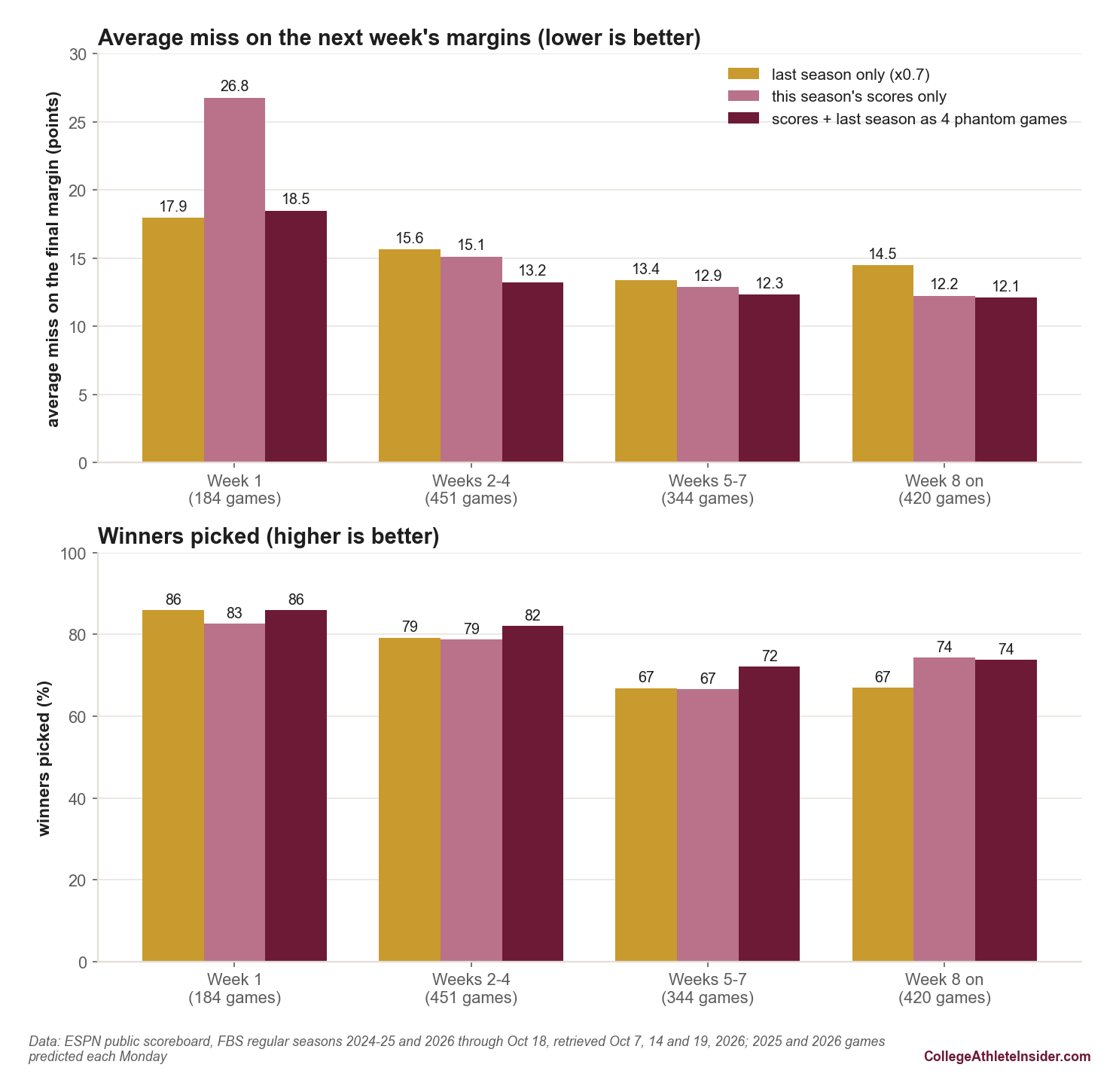
charts/chart_sp_plus_2026.py.| Games of | Games | Avg miss: last season | Scores only | Blended | Winners: last season | Scores only | Blended |
|---|---|---|---|---|---|---|---|
| Week 1 | 184 | 17.9 | 26.8 | 18.5 | 158 | 152 | 158 |
| Weeks 2-4 | 451 | 15.6 | 15.1 | 13.2 | 357 | 355 | 370 |
| Weeks 5-7 | 344 | 13.4 | 12.9 | 12.3 | 230 | 229 | 248 |
| Week 8 on (2025) | 420 | 14.5 | 12.2 | 12.1 | 281 | 312 | 310 |
Three things fall out of it.
In Week 1, last season is all you have. A rating built from a handful of Week 0 games misses by 26.8 points on average; last season's regressed rating misses by 17.9.
From Week 2 to Week 7, neither source alone is good enough, and the blend beats both. In Weeks 2-4 last season's rating and this season's scores are about equally bad (15.6 and 15.1 points), while the blend misses by 13.2 — 1.9 points a game better than scores alone (standard error 0.25) — and picks 82.0% of winners to 78.7%. In Weeks 5-7 the gap shrinks to 0.55 points (standard error 0.20), but the blend still picks 72.1% of winners to 66.6%. The pattern holds in each season on its own: 1.9 points in Weeks 2-4 of 2025 and 1.8 in 2026, which the 0.7 factor was never fit on.
From Week 8 on, the prior has done its job. The blend and the scores-only rating are within 0.14 points of each other (standard error 0.13), and last season's rating used alone is now 2.3 points a game worse than this season's scores. The projection hasn't been switched off; four phantom games just don't count for much against eight or nine real ones.
The result doesn't hinge on our settings. Re-run with last season pulled back toward average by anywhere from 20% to 50% (factors 0.8 to 0.5) and with 2, 4 or 8 phantom games, and the blend beats scores alone in Weeks 2-4 and in Weeks 5-7 in all 12 versions; from Week 8 on the difference stays between −0.24 and +0.15 points. It's the same lesson our piece on when a record starts to mean something found with win-loss records, now measured on margins: early results are real information, but not enough to stand alone.
This past weekend is a small live check. Rated through Monday, October 12, the three versions called 62 games of Week 7 (October 13-17): the blend picked 40 winners, scores alone 39 and last season alone 34, with average misses of 11.1, 11.2 and 11.9 points. Seven weeks in, scores and blend have nearly met, as 2025 said they would.
Where SP+ misleads
SP+ is a model, not gospel. A few honest caveats:
- Early season noise. With only a game or two played, the rating leans heavily on preseason projections — and, as the test above shows, it should. But a September number is mostly last year's team, so don't over-read it.
- It's descriptive and predictive, not a result. SP+ can rate a team that lost higher than one that won. That's a feature — it's measuring quality, not counting trophies — but it's not how championships are decided.
- Injuries and personnel changes aren't fully captured. A rating built on ten games doesn't know your quarterback just got hurt.
- Garbage time can leak in. Good systems down-weight it, but no adjustment is perfect.
- Even midseason, it misses by double digits. The best version in our test still missed the final margin by about 12 points a game from Week 5 on. A rating sharpens the odds of a game; it doesn't call the score.
Use SP+ the way you'd use any good instrument: as a sharper lens, not a verdict. It tells you, far better than the standings do, who has actually played well against whom. Pair it with your own eyes and you'll be right more often than the loudest person in the group chat.
Sources & further reading
- CollegeFootballData.com API reference, Ratings — api.collegefootballdata.com/api/ratings (the fields of a published SP+ record; read October 19, 2026; an API key is required for the data)
- CollegeFootballData.com, SRS ratings methodology — api.collegefootballdata.com/srs-ratings (a published scores-only, schedule-adjusted rating; read October 19, 2026)
- ESPN public scoreboard — every regular-season game involving an FBS team in 2024, 2025 and 2026 through October 18, used for the 2026 rating table and the prediction test; the 2024 one-pass example above uses the same source
- Our companion explainers: Success Rate and EPA, from scratch · An SoS-adjusted ranking in a sheet · When a record starts to mean something