Women's college basketball is booming — that part is true and not really arguable anymore. But when we went looking for the boom in the box scores, we found something more interesting than the narrative: the explosion isn't in the scoring. It's in the attention. The on-court product has gotten incrementally better; the audience for it has gotten transformationally bigger. Here's what the data actually says.
The scoring "boom" is mostly flat
Using full-season team box scores for every Division I game (via the public wehoop data; the script is kept in our build repository and not published), here's average scoring and three-point volume by season:
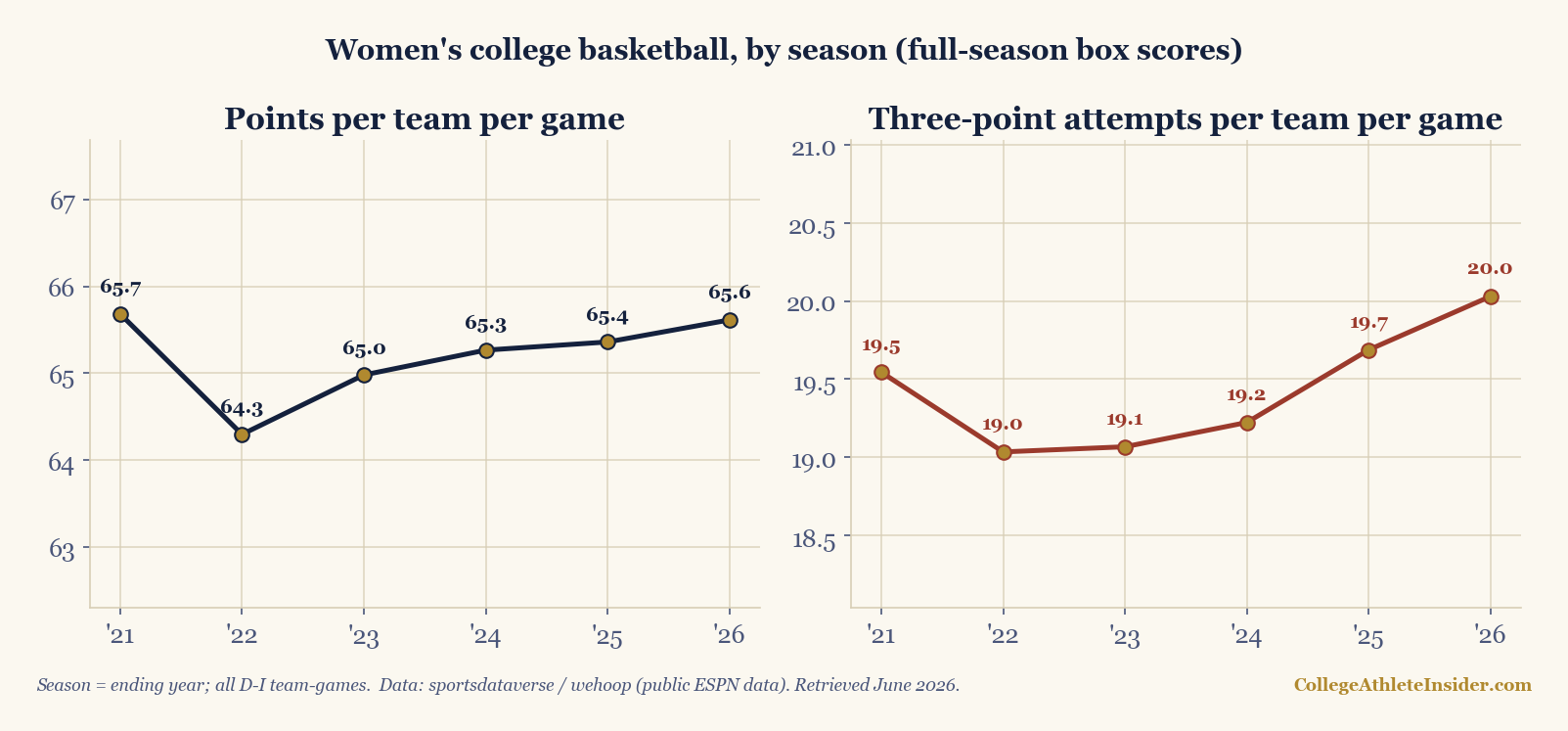
Across six seasons, average scoring sits stubbornly around 65 points per team — up perhaps a tenth of a point overall, which is to say, flat. Pace is steady near 71 possessions a game. The one genuine on-court trend is the three-pointer: attempts have crept from about 19.5 to 20.0 per team, and the 2025-26 season posted the highest scoring (65.6), pace (71.6), and three-point volume (20.0) of the six. So there is an upward drift — the game is getting a little faster and a little more perimeter-oriented — but "drift" is the honest word, not "boom."
If a commentator tells you scoring has exploded, they're describing the highlight reel of a few superstar offenses, not the league. The median game looks a lot like it did five years ago.
The actual boom: who's watching
Now look away from the court. The 2024 national championship — South Carolina against Caitlin Clark's Iowa — averaged 18.9 million viewers and peaked around 24 million. For the first time ever, the women's title game outdrew the men's, which pulled about 14.8 million. That is the boom: not points per game, but eyeballs, ticket demand, and media-rights value that have multiplied in a span of a few seasons.
This distinction matters because it changes what you'd expect next. If the boom were a scoring revolution, you'd predict the numbers to keep climbing. They probably won't, much. But an attention boom drives revenue, which drives investment — better facilities, charter travel, NIL money, and (post-House settlement) revenue sharing — which, over time, raises the talent floor. The product improvement tends to follow the audience, not lead it.
Men vs. women: a revealing comparison
Run the identical analysis on the men's game and a real stylistic difference emerges. In 2024-25, men's Division I averaged about 73 points per team on 69 possessions; women averaged 65 points on 71 possessions. Read that carefully: women play at a faster pace but score fewer points.
The gap is efficiency and shot profile. Men attempt and make more three-pointers (roughly 23 attempts per team to the women's 20, at higher accuracy), which inflates points per possession. The women's game, by contrast, generates more of its offense inside the arc and in transition. Neither is "better" — but it explains why raw point totals differ even though the women actually get more possessions to work with. It's a perfect illustration of why we always convert to points per possession instead of trusting points per game.
What to watch next
- Three-point rate. The clearest on-court trend. If the women's game keeps drifting toward the perimeter, scoring will tick up with it. Watch whether 3PA crosses into the low-20s leaguewide.
- The post-Clark audience. Viewership dipped from the 2024 peak once its signature star turned pro, as expected. The real test of the boom is the floor — whether the new, larger audience persists without a single transcendent name. Early signs say much of it has stuck.
- Investment flowing to the court. Revenue sharing and NIL will reach women's programs unevenly. If the money follows the audience, expect the talent — and eventually the scoring — to rise.
The honest headline
The women's game's statistical boom is real, but it's a boom in demand, not in scoring. The box scores have barely moved; the business has been transformed. That's not a knock on the basketball — it's a clearer picture of what's actually happening, and a better guide to what comes next. The audience arrived first. The numbers, if history holds, will follow.
Sources & further reading
- sportsdataverse / wehoop — sportsdataverse.org (full-season box scores)
- Public reporting on 2024 championship viewership (NPR, NBC News)
- Related: Adjusted tempo and efficiency