The bracket is a national guessing game (no picks here — just analysis), and two questions resurface the moment it's unveiled: which seed lines actually produce upsets, and what do the giant-killers have in common? The tournament has handed us four decades of data since the field expanded to 64 in 1985. The answers are clearer than the chaos makes them feel.
Where the upsets actually live
"Upset" gets thrown around loosely, so let's define it as a lower seed beating a higher seed in the first round. Plot the win rate for the famous upset-zone matchups since 1985 and a clean pattern appears:
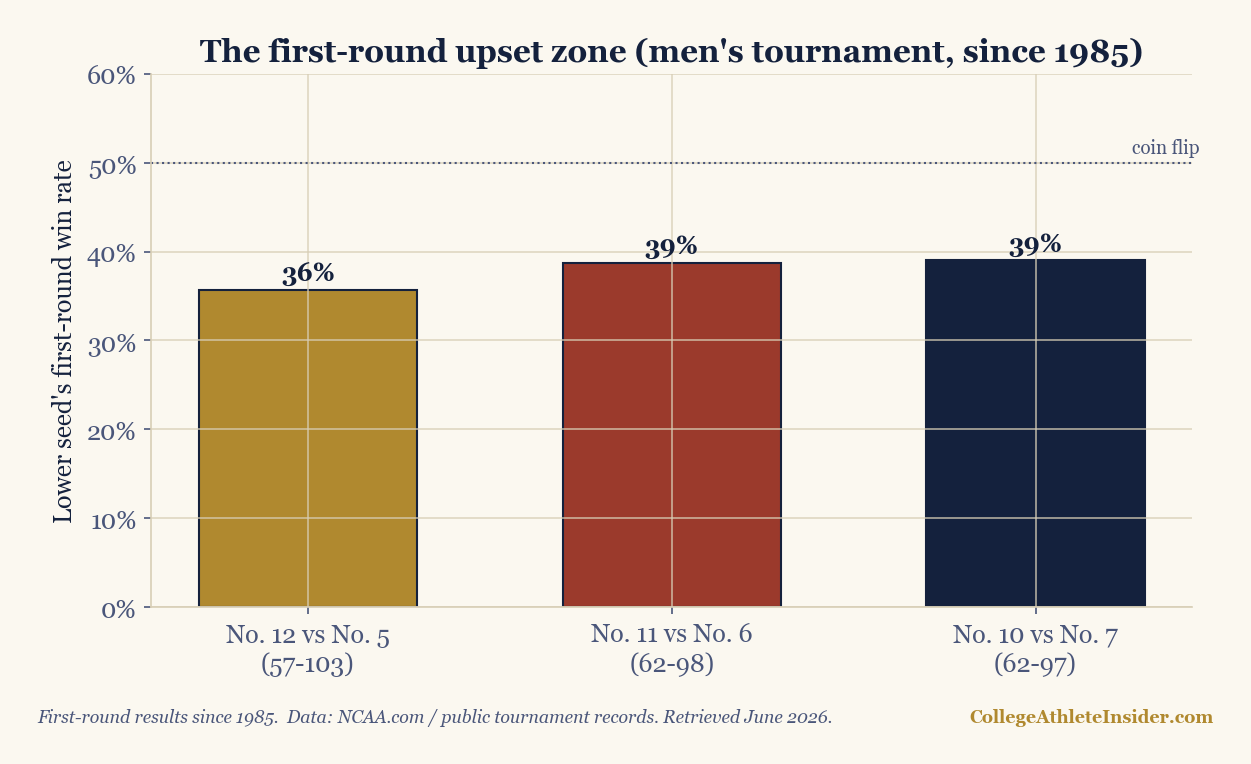
| Matchup | Lower seed record | Upset rate |
|---|---|---|
| No. 10 over No. 7 | 62-97 | 39.0% |
| No. 11 over No. 6 | 62-98 | 38.8% |
| No. 12 over No. 5 | 57-103 | 35.6% |
The famous "12-over-5" is real — it happens better than a third of the time — but it is not even the most likely first-round upset. The 10-over-7 and 11-over-6 lines are slightly more upset-prone, both near 39%. The reason is the same reason 12-5 gets the hype: by that point in the bracket, the gap in actual team quality between the seeds is small. A 5 and a 12 are closer in true strength than their seed numbers suggest, because seeding is lumpy — the committee's 5-line and 12-line aren't four "tiers" apart in reality.
The tails: rare, and getting slightly less rare
Push to the extreme seeds and upsets dry up fast. A No. 15 has beaten a No. 2 only about a dozen times in 40 years. A No. 16 has beaten a No. 1 just twice — UMBC over Virginia in 2018 and Fairleigh Dickinson over Purdue in 2023. That both 16-over-1 shocks happened in a recent six-year window is probably a hint that the talent floor of mid-major champions has risen (the transfer portal lets good mid-majors keep, or import, experienced players). But these remain lightning strikes, not a strategy.
What giant-killers have in common
The teams that pull first-round upsets aren't random. The statistical profile of a dangerous lower seed tends to include:
- Veteran guard play. Experienced, ball-secure guards who don't wilt against pressure are the single most common trait. March is a guard's month.
- Three-point variance. A team that lives behind the arc has a higher ceiling on any given night. The three-pointer is the great equalizer: it lets a less talented team "borrow" points quickly. (The flip side: it's volatile, which is why these teams are upset candidates, not favorites.)
- A real defense. The forgotten half of the formula. Upsets usually require holding a more talented team below its efficiency, not just getting hot. Good defensive lower seeds are far more dangerous than one-dimensional gunners.
- Free-throw and turnover discipline. Close games are decided at the margins. Teams that don't beat themselves — low turnovers, makes at the line — convert close games into upsets.
- An efficiency rating better than the seed. The most reliable tell is simple: a lower seed whose adjusted efficiency (see our tempo and efficiency guide) is much closer to its opponent's than the seed gap implies. The ratings see quality the bracket line obscures.
How to think about it (not bet on it)
If you're filling out a bracket for fun, the math suggests a few sane habits: expect roughly one or two 10/11/12 upsets in the first round (they happen most years), don't force a 15 or 16 special, and weight a lower seed's efficiency rating over its seed number. The committee's seeds are good but coarse; the ratings are finer. When the two disagree by a lot, the ratings have the better track record.
And remember what the percentages really say: the "upset" zone exists because seeding can't perfectly rank 68 teams. The madness isn't randomness — it's the visible gap between a tidy bracket and a messy, glorious reality where the 39% happens often enough to ruin everyone's pool.
Sources & further reading
- NCAA.com — ncaa.com (tournament history and records)
- sportsdataverse / hoopR — sportsdataverse.org (team efficiency inputs)
- Related: Adjusted tempo and efficiency · The at-large math