Conference realignment is usually discussed in the language of television money and wounded tradition. Both matter. But realignment also did something you can measure in plain units — miles, and competitive balance — and the measurements are more dramatic than the press releases let on. A "Big Ten" team now flies past four time zones to play a conference game. Let's quantify the new map.
The map got enormous
The cleanest, least-disputable effect of realignment is geography. Take the simplest measure — the average great-circle distance between every pair of conference members — and compute it before and after the latest moves (campus coordinates are public; the script that does it is kept in our build repository and not published):
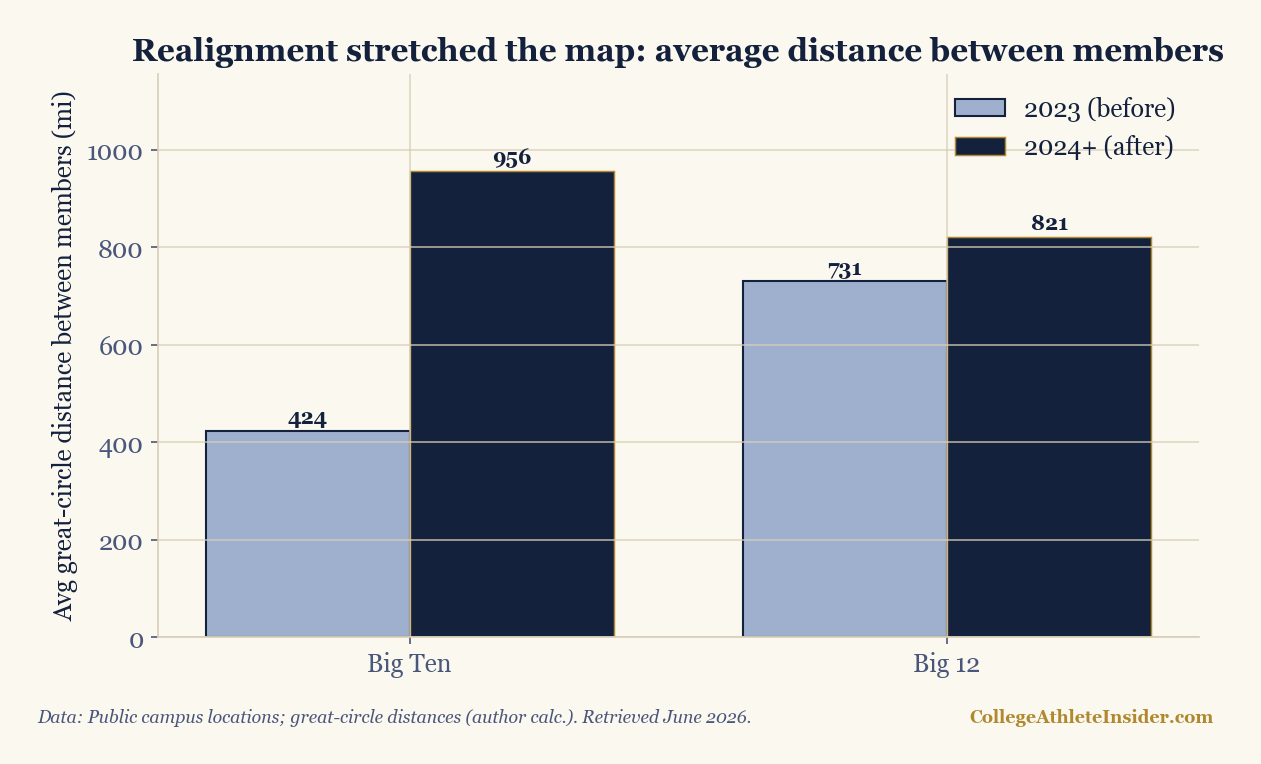
The Big Ten's average distance between members jumped from about 424 miles to roughly 956 — it more than doubled — once UCLA, USC, Oregon, and Washington joined a league anchored in the Midwest and Mid-Atlantic. The longest single pairing, Rutgers to Oregon, is about 2,462 miles — a coast-to-coast conference "rivalry." The Big 12, which absorbed four former Pac-12 schools, grew more modestly (about 731 to 821 miles, +12%), because it was already a sprawling, central-time-zone league; its longest pairing, UCF to Utah, runs about 1,920 miles.
These aren't abstractions. They're missed class time, late-night returns, jet-lagged bodies, and travel budgets that now rival professional leagues — borne disproportionately by athletes in non-revenue sports who fly the same routes as football without the charter-flight treatment. When people say realignment was done "for football TV money," the mileage is the receipt.
Parity: the rich got concentrated
The competitive story is subtler but real: realignment didn't spread the best teams around — it gathered them. The 2025 College Football Playoff field included five SEC teams and three Big Ten teams; eight of twelve playoff spots came from two conferences. The first 12-team champion (Ohio State) and the second (Indiana) both came from the Big Ten. Power, measured by who reaches the bracket, has pooled in the two superconferences.
Inside those leagues, that concentration cuts the other way: more good teams in one conference means more brutal weeks and more quality losses. A three-loss SEC or Big Ten team can be better than a one-loss team from a thinner league — which is exactly the schedule-adjustment problem we cover in our strength-of-schedule explainer. Realignment made conference records harder to read, not easier.
Power ratings: the part that needs a key
To put a precise number on how realignment shifted the distribution of team strength — did the gap between the best and the median widen? — the right tool is an opponent-adjusted rating like SP+, pulled across seasons:
What we can say with confidence
- Travel exploded, unevenly. The Big Ten became a transcontinental league; the Big 12 stretched less because it was already wide. The cost lands hardest on athletes.
- Talent concentrated. Two conferences now supply most of the playoff. That's great for their TV inventory and rough for everyone trying to crash the party.
- Records got harder to interpret. Deeper leagues mean more quality losses; you can't compare conference records at face value anymore.
The trade nobody voted on
Realignment delivered exactly what it was designed to deliver: bigger media footprints and marquee inventory for the conferences that consolidated. The bill — measured in miles flown, parity lost, and the strange new sight of West Coast schools playing "conference games" in New Jersey — is being paid largely by the athletes, who had no seat at the negotiating table. The map is the clearest evidence of who the new college sports are actually built for.
Sources & further reading
- Public campus locations (great-circle distances computed by the companion script)
- College Football Playoff — collegefootballplayoff.com (2025 field composition)
- Related: Strength of schedule · The 12-team playoff, by the numbers