We spent thirty years arguing about how many teams should play for a national title, and now, two seasons into the twelve-team College Football Playoff, we finally have games instead of opinions to argue over: first-round byes, home playoff sites, a bracket that stretches from December into a January final. Two cycles is a small sample and we'll keep saying so. But it's enough to check the format against the promises that were made for it — and the first thing the data does is embarrass the most confident of those promises, the one about that prized first-round bye.
How the bracket works (and what changed)
Twelve teams: the bracket grants first-round byes to the top four seeds, while seeds 5 through 12 play first-round games on the higher seed's home campus. The four first-round winners advance to quarterfinals staged in the traditional New Year's bowls; then semifinals, then the championship.
One important rule already changed. In the 2024 season, the top four seeds — and the byes — were reserved for the four highest-ranked conference champions, which is how Boise State and Arizona State landed byes ahead of higher-ranked teams. For the 2025 season, the format switched to straight seeding: the four byes simply go to the top four ranked teams, while five conference champions are still guaranteed spots (the highest-ranked Group of Five champion takes the No. 12 seed). That's the kind of detail that moves a team a full round, so treat any "how seeds perform" analysis as rules-dependent. (Format as of August 2026: the CFP has confirmed the 2026 season bracket stays at 12 teams with straight seeding — the third season at this size — with selections on December 6 and the first round starting December 18.)
The bye is supposed to be an advantage. It hasn't been.
The whole point of finishing in the top four is the reward: a week off while everyone else brawls. Logical. Also, so far, wrong.
Across both playoffs, teams coming off a first-round bye are 1-7 in their quarterfinal openers. In 2024, all four bye teams — Oregon, Georgia, Boise State, Arizona State — lost their first game. In 2025, only top-seeded Indiana survived; Ohio State, Georgia, and Texas Tech all fell. The team that just played a competitive game the week before kept winning; the rested favorite kept losing.
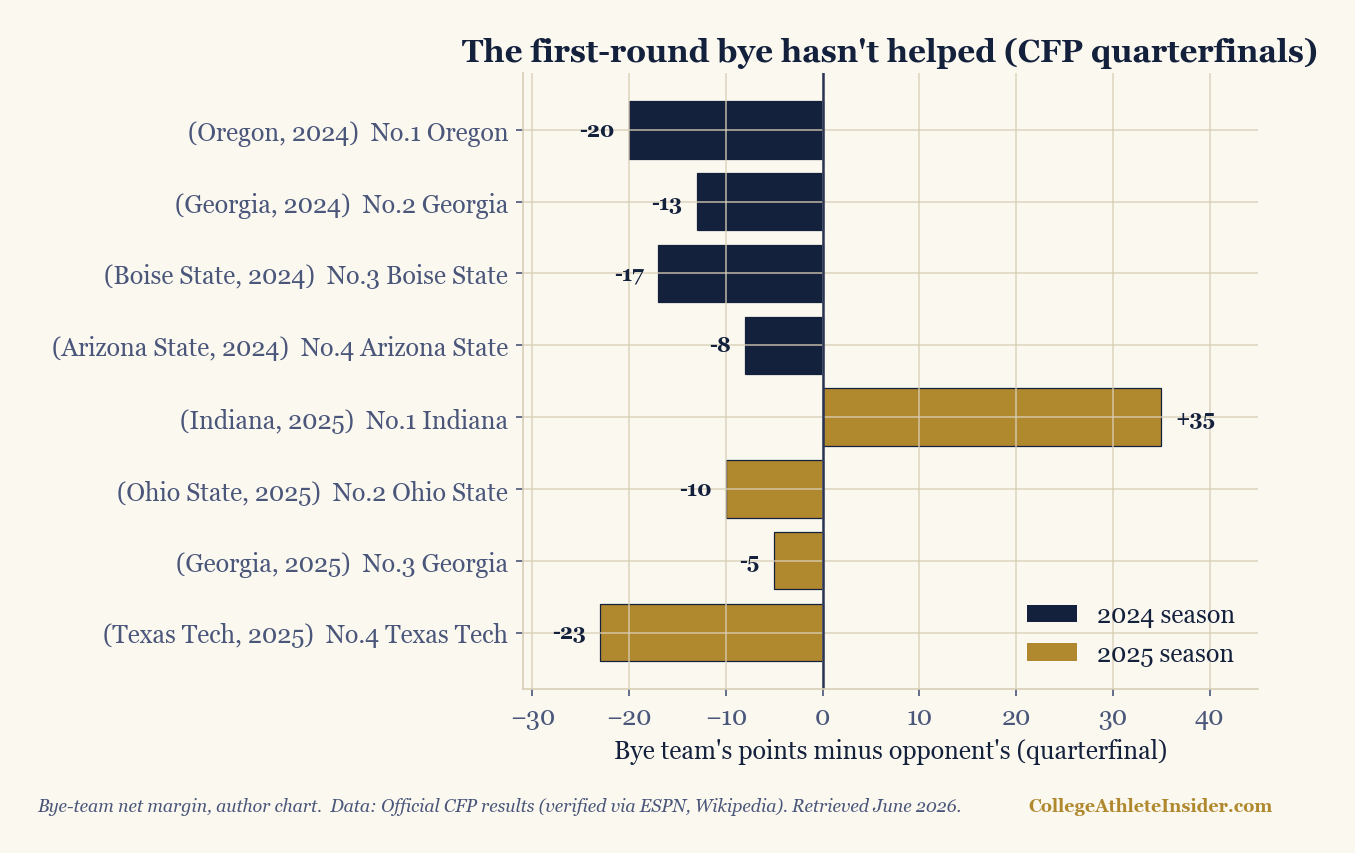
Is it the rust? The step up in competition from a tune-up to a battle-tested opponent? Two seasons can't prove causation, and regression to the mean will probably pull that number back toward .500. But the confident preseason claim that a bye is a near-decisive edge is, for now, unsupported by the games actually played.
The full ledger
| Round | 2024 season | 2025 season |
|---|---|---|
| First round | Higher seeds 4-0 | Higher seeds 2-2 (Alabama, Miami won as road underdogs) |
| Quarterfinals (byes) | Byes 0-4 | Byes 1-3 (only Indiana advanced) |
| Title game | Ohio State 34, Notre Dame 23 | Indiana 27, Miami 21 |
| Champion (seed) | Ohio State (No. 8) | Indiana (No. 1) |
Lower seeds can win the whole thing
The other promise of expansion — that more teams means more live contenders — is holding up. The first 12-team champion was the No. 8 seed, Ohio State, which had to win four games to do it. A No. 7 (Notre Dame) and a No. 10 (Miami) reached the two title games. The bracket is not just a coronation of the top seed; in 2024 it was anything but.
And then 2025 offered the counterpoint: No. 1 Indiana ran the table to finish 16-0, the first major-conference team to win that many games in a season in the modern era. So in two tries we've seen both outcomes — a deep run by a middle seed and a wire-to-wire march by the top seed. That's arguably the healthiest result for the format: the bracket is neither chalk nor chaos.
First-round home games are real home games
Hosting on campus in December was supposed to matter, and in 2024 it did — higher seeds went 4-0 at home. But 2025 punctured the inevitability: Alabama won at Oklahoma and Miami won at Texas A&M, both lower seeds winning on the road. Combined, higher seeds are 6-2 in first-round games. The home field helps; it doesn't decide.
What two years actually taught us
- The bye is not the trophy. Until the sample says otherwise, finishing top four buys rest, not a result.
- Seeding rules matter as much as seeds. The 2024-to-2025 switch to straight seeding changed who got byes — a reminder to date-stamp any analysis.
- Expansion delivered live underdogs without turning the bracket into a lottery. An 8 seed and a 1 seed have both won it.
The twelve-team era is young, and a third or fourth cycle could flip these early trends. But that's the fun of it: for the first time, college football has a postseason big enough to generate real data — and honest enough to embarrass our preseason certainties. The bye, of all things, was the first to go.
Sources & further reading
- College Football Playoff — collegefootballplayoff.com (official results and format)
- NCAA.com — 2026-27 CFP schedule and format (12 teams, straight seeding confirmed for 2026)
- ESPN — espn.com (game results, used to verify scores)
- Related: From the BCS to the 12-team playoff