Raw offensive and defensive efficiency — points scored and allowed per 100 possessions — are the right units for basketball. But they're not fair until you adjust for the opponent: scoring 110 against the best defense in the country is worth more than 110 against a sieve. Opponent-adjusted efficiency is the engine behind every serious rating system, and it's just one idea repeated until the numbers settle. Let's build it. The full script is reproduced below.
Start with raw efficiency
For each team-game, estimate possessions and compute efficiency on both ends:
poss    = FGA - OREB + TOV + 0.475 * FTA
off_eff = 100 * team_score / poss
def_eff = 100 * opponent_score / poss
Average those over a season and you have raw ratings. The problem: they don't know schedule strength. Now we fix that.
The iterative adjustment
The trick is circular in the best way. A team's adjusted offense is its raw offense, corrected for how good each opponent's defense was — but "how good each defense was" is itself an adjusted number. So you guess, then refine:
L = league_average_efficiency
for _ in range(12):                 # repeat until stable
    for t in teams:
        adjO[t] = mean( off_eff_g - (adjD[opp] - L)  for each game g )
        adjD[t] = mean( def_eff_g - (adjO[opp] - L)  for each game g )
AdjEM = adjO - adjD # net ratingRead the adjustment literally: if you scored 108 (off_eff_g) against a defense that's 6 points better than average (adjD[opp] - L = -6), your adjusted offense for that game is 108 - (-6) = 114. You get credit for scoring on a tough defense.
The result
On the 2024-25 men's season, the iteration lands exactly where the public ratings did:
League efficiency L = 106.0 pts/100. Top by adjusted margin:
 1 Duke           +47.6  (AdjO 132.9 / AdjD 85.3)
 2 Houston        +45.2  (AdjO 126.5 / AdjD 81.3)
 3 Auburn         +43.2  (AdjO 130.9 / AdjD 87.8)
 4 Florida        +41.8  (AdjO 129.6 / AdjD 87.8)
 5 Tennessee      +38.0  (AdjO 123.3 / AdjD 85.3)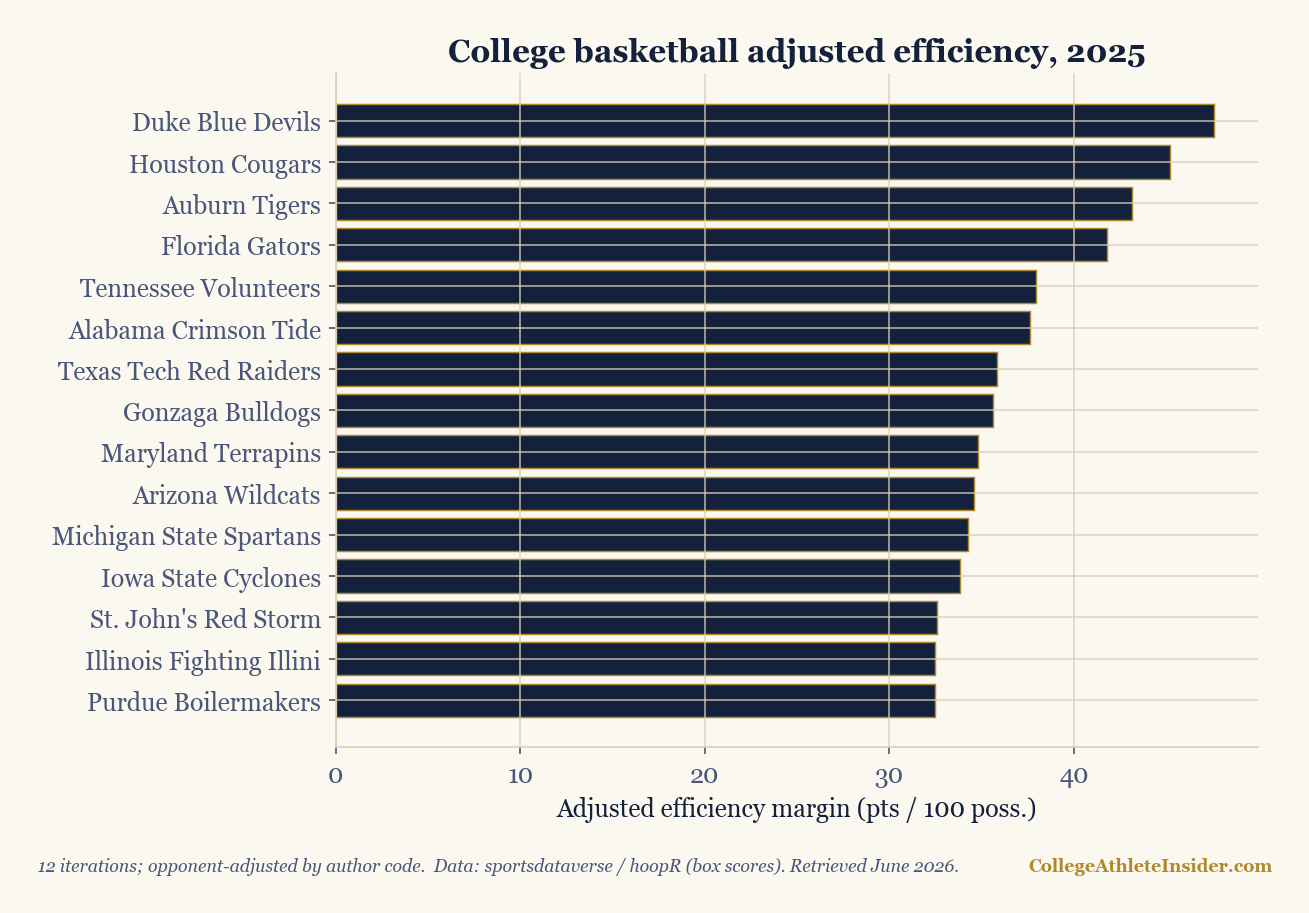
Those four at the top were the actual national semifinalists — your homemade rating found them with a dozen lines of arithmetic. Note that Duke leads on adjusted margin even though Florida won the title: like Elo, this rates the season's quality, not the bracket's outcome. The league average lands at exactly 106 points per 100, the natural yardstick everything is measured against.
Refinements
- Home-court. Adjust each game's efficiency for venue before averaging (a few points per 100).
- Recency & weighting. Down-weight blowouts and early-season games.
- Tempo-free by design. Because everything is per-100, fast and slow teams compare fairly — see tempo profiles.
- Women's game: swap
mbbforwbb; identical code.
This is the same logic as football's spreadsheet ranking, just in possession units. Once you've built it, no "power ranking" is a black box to you again.
Sources & further reading
- sportsdataverse / hoopR — sportsdataverse.org
- Bart Torvik's T-Rank — barttorvik.com (a public reference rating)
- Companion script, kept in our build repository and not published:
scripts/cbb-adjusted-efficiency-python.py - Related: The four factors · Why adjust at all